I started with the Level 3 Community Interpreting Course. Here’s where it took me.
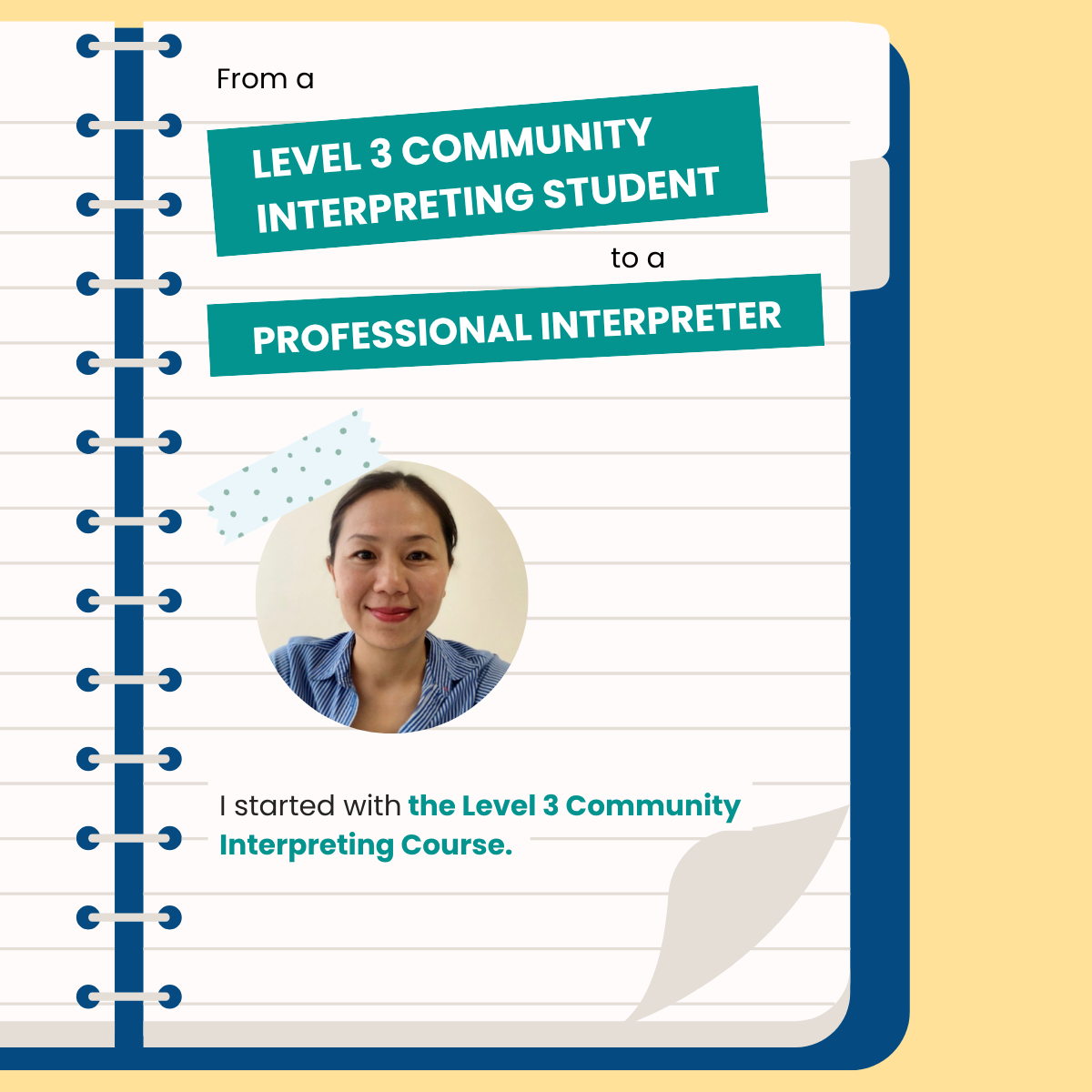
I started with the Level 3 Community Interpreting Course. Here’s where it took me.
For Kate Bryant, the Level 3 Community Interpreting Course began as something useful to do while her daughter was at school. She had no carefully mapped-out career plan and no idea that this first step would eventually lead to more than two decades of professional interpreting.
Since then, Kate has worked across healthcare, social services, courts, police services, the Home Office and the private sector. She has gained the Diploma in Public Service Interpreting (DPSI), completed a Master’s in Translation and built a successful career as a professional interpreter.
But when she enrolled on her Community Interpreting training Vandu Languages, none of that was part of the plan.
Returning to learning after six years away
Originally from Taiwan, Kate moved to the UK in 1998. She speaks Mandarin Chinese, English and Taiwanese and had some informal interpreting experience before coming to Britain.
After having her daughter, however, her circumstances changed.
“I didn’t have anyone here at the time, so I had to be a full-time mum,” she explains.
For around six years, work and study took a back seat. So when her daughter started school full-time, enrolling on a Level 3 Community Interpreting Course was partly about doing something for herself again.
“I didn’t do it thinking that I’m going to work as an interpreter,” Kate says. “I thought I would find something that I could enjoy and learn.”
Would the Level 3 Community Interpreting Course feel intimidating?
Returning to education after several years could easily have been uncomfortable. Kate, however, remembers being surprised by how informal the atmosphere felt.
“Very relaxed,” is her immediate description.
She studied alongside people from different backgrounds and stages of life. Instead of feeling like she had returned to an intimidating classroom, she found the environment sociable and welcoming.
“It didn’t feel like I was attending a proper course because it was just like friends and the atmosphere was very relaxed.”
Kate completed her Community Interpreting training face-to-face many years ago. Today, Vandu Languages delivers its Level 3 Community Interpreting Course online, making it easier for students to study around work, family and other responsibilities.
For someone in the position Kate was in then, that flexibility can matter.
She spoke the languages. There was still plenty to learn.
Kate already had strong language skills when she enrolled. But the course quickly exposed another gap in her knowledge.
She had been living in Britain for six or seven years, yet she realised she did not fully understand how some of the public services around her actually worked.
“That was quite helpful information regarding how the infrastructure of the governmental authorities [works],” she says.
Understanding services such as the NHS and social services became important once Kate started undertaking Community Interpreting assignments.
It also challenged an assumption that she would encounter repeatedly throughout her career: that professional interpreting is simply about being able to speak two languages.
It isn’t.
What does a Community Interpreter need beyond language skills?
An interpreter can be present when someone is discussing their health, family circumstances or legal situation. Getting the message approximately right is not enough.
Community Interpreting training introduces students to responsibilities including:
- accuracy and completeness;
- confidentiality;
- impartiality;
- professional boundaries;
- preparation and terminology research; and
- appropriate professional conduct.
These principles can sound theoretical until you imagine an actual assignment.
A bilingual relative might help someone understand a conversation at a hospital. A trained Community Interpreter, however, understands how to facilitate communication accurately and impartially without taking over the conversation or speaking on the person’s behalf.
That distinction became increasingly important to Kate as her professional interpreting career developed.
The most valuable lesson.
Of all the things Kate learnt during her course, one surprisingly simple exercise followed her throughout her career.
She had to build a bilingual glossary.
Kate began collecting terminology that she might encounter during Community Interpreting assignments. More than two decades later, she is still adding to it.
“I have my own glossaries and everything, and I have developed the habit of writing words on my computer and my phone. So I’m still building my glossary.”
It reflects something prospective interpreting students may not initially expect: interpreters never really finish studying.
A new medical condition, legal term or unfamiliar service can require preparation. Professional interpreting demands continual learning because no interpreter can know every term they will encounter.
Then came the first real assignment
Completing the course was one thing. Walking into an appointment as the interpreter was another.
The practical nerves of finding the appointment were soon replaced by something else: she discovered that she genuinely enjoyed the work.
“I remember enjoying interpreting a lot because I still do now every day. I look forward to going to appointments.”
Initially, Kate might work once or twice a week. The assignments gave her something separate from family life and a growing sense that her language skills could be useful professionally.
She particularly remembers the end of appointments.
“People [were] thanking me, whether it’s a doctor or the patient, and I thought, ‘Oh, my job’s done today,’ and I’m so happy, looking forward to the next booking.”
The course she had taken simply to learn something new was starting to look like a career.
The next difficult step.
Kate’s early Community Interpreting assignments included the NHS, social services, children’s services and solicitor appointments.
As she gained experience, people began suggesting that she could go further.
One solicitor encouraged her to consider progressing into more specialist interpreting after they saw her interpret in court.
There was one problem: the next qualification was much tougher to pass.
Kate knew about the Diploma in Public Service Interpreting (DPSI), but she was intimidated by the examination. She postponed doing the qualification for a while.
Eventually, she made it a New Year’s resolution.
“I said, ‘I will take DPSI next year.’”
With only months to prepare, she committed herself to studying.
She passed on her first attempt.
“That’s when I realised, wow, if I really want to do something, I actually can do it. My confidence grew from that.”
Where did the DPSI qualification lead?
A Level 3 Community Interpreting qualification provides a foundation for working in community settings and introduces the core skills, ethics and responsibilities of professional interpreting.
The DPSI is a more advanced qualification designed for interpreters working in specialist public-service settings, with pathways covering areas such as law and health.
Passing the DPSI expanded the kind of professional interpreting Kate could undertake.
She moved into court and police interpreting and, over the years, worked across healthcare, social services, legal settings, the Home Office and the private sector. Her experience also grew to include conference interpreting.
Today, Kate works freelance, is registered with several agencies and is on the National Register of Public Service Interpreters (NRPSI). She also continues to undertake assignments with Vandu Languages.
None of that happened simply because she completed one course.
The Level 3 Community Interpreting Course gave her a foundation. Experience, further qualifications and years of learning followed.
“You definitely need… to constantly… keep mastering it, polishing it, because we all make mistakes and we learn from mistakes,” she says.
Why does she still do it?
After more than two decades of professional interpreting, Kate still talks enthusiastically about going to appointments.
One reason is the challenge.
She describes navigating complicated medical conversations where specialist terminology has to be understood and communicated accurately. Her aim is to make the exchange between patient and healthcare professional feel as natural as possible.
“When the session is achieved, I always make sure everything was understood,” she says.
The satisfaction comes from knowing that a conversation which might otherwise have been difficult has actually worked.
“I help people and I also did something good for myself… That feels very fulfilling.”
For Kate, that combination of intellectual challenge, communication and practical impact has kept the work interesting decades after her first assignment.
Could Community Interpreting be a career for you?
Kate is particularly cautious about one assumption prospective interpreters can make.
“Because you can speak more than one language, it doesn’t mean you will become an interpreter.”
Being bilingual is the starting requirement, not the finished skill.
Professional interpreting also involves accuracy, confidentiality, preparation, impartiality and knowing how to behave when conversations become complicated or sensitive.
“You have to have what it takes to really take this job seriously,” Kate says.
That is why Community Interpreting training matters. It helps bilingual people begin turning an existing language ability into a professional skill.
Kate could not have predicted where her training would lead when she got handed that leaflet.
At the time, she was a mother returning to learning after six years away. Then came her first Community Interpreting assignment, the intimidating DPSI examination, court and police work and more than two decades of interpreting.
For prospective interpreting students considering Vandu Languages’ Level 3 Community Interpreting Course, Kate’s career offers a useful example of what the qualification can be: not a guarantee of where you will end up, but practical training that can give you somewhere to start.
Find out more about the Level 3 Community Interpreting Course at https://driorg.com/level-3-community-interpreting-course/ or contact training@driorg.com